Faculty

Dr. Jacinta Conrad is a physical scientist studying transport and dynamics within soft, complex materials and matrices. Using a range of microscopy, rheology, scattering, and computational methods, her group seeks to understand how microscale particles, including colloids, nanoparticles, bacteria, viruses, and proteins, explore and/or transport through confined and crowded environments. Insights gained from fundamental studies of these non-equilibrium processes inform the design of new materials for preventing fouling and corrosion, for remediating environmental damage, and for sensitively diagnosing disease. She earned an SB in Mathematics from the University of Chicago and MA and PhD degrees in Physics from Harvard. She worked as a postdoctoral associate in Materials Science and Engineering at the University of Illinois before starting her faculty position at the University of Houston (UH) in 2010. Currently, she is the Frank M. Tiller Professor of Chemical Engineering at UH and an Executive Editor at ACS Applied Nano Materials. She is a Fellow of the American Physical Society and the Society of Rheology.
Our goal is to understand how complex fluids (including suspensions of polymers, colloids, nanoparticles, bacteria, viruses, and/or proteins) assemble and transport near surfaces that confine, crowd, or support them. This broad class of problems is scientifically fascinating the chemical and mechanical properties of surfaces and fluids can influence behaviors such as adhesion, diffusion, and motility. This class of problems also underpins important applications in materials processing, point-of-care diagnostics, and bioremediation, among others.
Microbiology Near Interfaces
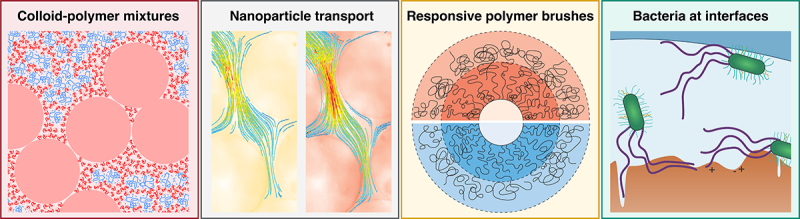
We use microfabrication and microscopy to investigate how bacteria move on, interact with, and adhere to interfaces (solid surfaces and fluid-fluid interfaces). We are working with Patrick Cirino (UH ChBE) to engineer bacterial motility. Previously, we collaborated internally with Megan Robertson (UH ChBE) to prepare polymer substrates that modify bacterial motility and adhesion and externally with Arezoo Ardekani (Purdue), Douglas Bartlett (UCSD/Scripps), and Roseanne Ford (Virginia) to understand the role of motility on biodegradation. Applications of this work include medical diagnostics, antifouling materials, and bioremediation.
Flow of Colloids and Colloid-Polymer Mixtures
We use confocal microscopy and bulk rheology to investigate the relationship between structure and mechanical properties for ordered (crystalline) and disordered (gels, glasses) colloidal suspensions during microchannel flow. We are working with Jeremy Palmer (UH ChBE) to develop simulations of particule transport in complex, crowded media and have collaborated externally with Vivek Sharma (UIC). Applications for this work include feedstocks for 3D printing and advanced coatings.
Nanoparticles in Transport
We use microfabrication and microscopy to investigate the transport properties of nanoparticles in model porous media and in non-Newtonian fluids (with Amanda Marciel (Rice ChBE) in polymer brushes and Rae Robertson-Anderson (Univ. San Diego) in DNA solutions; previously we worked with Ramanan Krishnamoorti (UH ChBE) to study transport in polymer solutions). Applications for this work include drug delivery and nanocomposite processing.
Biomedical Applications: Lateral Flow Assays
We use microfluidics and particle-tracking to improve the sensitivity of lateral flow assays, a cheap and convenient point-of-care test, to detect proteins, viruses, and bacteria (with Richard Willson and Katerina Kourentzi, UH ChBE). Applications for this work include ultrasensitive diagnostics for bioterrorism and public health.
- Graduate students: Maede Chabi, Gary Chen, Peter Edimeh, Mariah Gallegos, Udayanidhi Ramesh Kumar, Farshad Safi Samghabadi, Diego Soetrisno
- Undergraduate students: none currently; please reach out!
2023 Five Sigma Physicist, American Physical Society
2022 Fellow, American Physical Society
2021 Fellow, Society of Rheology
2021 Outstanding Referee, American Physical Society
2020, 2021 Outstanding Reviewer, Soft Matter (RSC)
2020 Senior Faculty Research Excellence Award, Cullen College of Engineering
2019 ACS Petroleum Research Fund Reviewer Award
2019 Participant, EU-US Frontiers of Engineering
2018 University of Houston Alumni Association Outstanding Faculty Award
2017 – 2018 University of Houston Excellence in Research, Scholarship, or Creative Activity Award (Associate Professor level)
2017 – 2018 University of Houston Energy Fellow
2016 Speaker, Arab-American Frontiers of Science, Engineering and Medicine
2015 University of Houston WGRC Distinguished Faculty Scholar, Pre-Tenure
2014 Participant, Arab-American Frontiers of Science, Engineering and Medicine
2013 Participant, National Academies Keck Futures Initiative
2013 Junior Faculty Research Excellence Award, Cullen College of Engineering
2012 NSF CAREER
2010 University of Houston New Faculty Award
2005 – 2007 INEST Postdoctoral Fellowship
1999 – 2002 NSF Graduate Fellowship
2022 – 2024 Awards Committee, American Institute of Chemical Engineers
2021 – 2023 Awards Committee, American Chemical Society COLL Division
2020 – 2024 Executive Committee (Chair Line), American Physical Society Division of Soft Matter
2020 – 2022 Metzner Award Committee, Society of Rheology
2019 – present Associate Editor (2019 -- 2022) and Executive Editor (2023 -- present), ACS Applied Nano Materials
2019 – present Editorial Advisory Board, Soft Matter
2018 – 2020 Education Advisory Resource Group, AIP
2018 Editorial Board, ACS Applied Nano Materials
2017 – 2024 Symposium Committee (COLL Division), ACS
2016 – 2026 Fluids Programming Committee (Area 1J), AIChE
2014 – 2017 Education Committee, Society of Rheology
Member: American Physical Society, American Chemical Society, American Institute of Chemical Engineers, and the Society of Rheology.
Journal Papers / Refereed Journal Publications
- D. D. Soetrisno, C. D. V. Martínez Narváez, V. Sharma, and J. C. Conrad, “Concentration regimes for extensional relaxation times of unentangled polymer solutions.” Macromolecules 56, 4919 – 4928 [DOI], 2023
- D. Fan, S. Ramezani Bajgiran, F. Safi Samghabadi, C. Dutta, E. Gillett, P. J. Rossky, J. C. Conrad, A. B. Marciel, and C. F. Landes, “Imaging heterogeneous 3D dynamics of individual solutes in a polyelectrolyte brush.” Langmuir 39, 8532 – 8539 [DOI] , 2023
- F. Khakzad, N. K. Dewangan, T.-H. Li, F. Safi Samghabadi, R. Herrera Monegro, M. L. Robertson, and J. C. Conrad, “Fouling resistance and release properties of poly(sulfobetaine) brushes with varying alkyl chain spacer lengths and molecular weights.” ACS Appl. Mater. Interfaces 15, 2009 – 2019 [DOI], 2023
- J. C. Conrad and M. L. Robertson, Shaping the structure and response of surface-grafted polymer brushes via the molecular weight distribution.” JACS Au 3, 333 – 343 [DOI], 2023
- M. Chabi, B. Vu, K. Brosamer, M. Smith, D. Chavan, J. C. Conrad, R. C. Willson, and K. Kourentzi, “Smartphone-read phage lateral flow assay for point-of-care detection of infection.” Analyst 148, 839 – 848 [DOI], 2023
- M. J. Gallegos, D. D. Soetrisno, F. Safi Samghabadi, and J. C. Conrad, “Effects of polymer molecular weight on structure and dynamics of colloid-polymer bridging systems.” J. Phys. Chem. B 127, 3969 – 3978 [DOI], 2023
- R. C. Roberts, J. C. Palmer, and J. C. Conrad, “Long wavelength fluctuations in quasi-2D supercooled liquids.” J. Phys. Chem. B 127, 961 – 969 [DOI], 2023
- X. Yuan, H. W. Hatch, J. C. Conrad, A. B. Marc¬¬iel, and J. C. Palmer, “pH response of sequence-controlled polyampholyte brushes.” Soft Matter 19, 4333 – 4344 [DOI], 2023
- A. H. Slim, W. H. Shi, F. Safi Samghabadi, A. Faraone, A. B. Marciel, R. Poling-Skutvik, and J. C. Conrad, “Electrostatic repulsion slows relaxations of polyelectrolytes in semidilute solutions.” ACS Macro Lett. 11, 854 – 860 [DOI], 2022
- F. Safi Samghabadi, A. H. Slim, M. W. Smith, M. Chabi, and J. C. Conrad, “Dynamics of filamentous viruses in polyelectrolyte solutions.” Macromolecules 55, 10694 – 10702 [DOI], 2022
Conference Proceedings Publications
JOURNAL PAPERS / REFEREED JOURNAL PUBLICATIONS
- D. J. Harris, J. C. Conrad, and J. A. Lewis, “Evaporative lithographic patterning of binary colloidal films.” Phil. Trans. R. Soc. A. 367, 5157–5165 [DOI], 2009
Link to file - J.C. Conrad and J.A. Lewis, “Structure of colloidal gels in microchannels.” Langmuir 24, 7628–7635 [DOI], 2008
Link to file - D.J. Harris, H. Hu, J.C. Conrad, and J.A. Lewis, “Patterning colloidal films via evaporative lithography.” Phys. Rev. Lett. 98, 148301 [DOI], 2007
Link to file - J.C. Conrad, P.P. Dhillon, E.R. Weeks, D.R. Reichman, and D.A. Weitz, “Contribution of slow clusters to the bulk elasticity near the colloidal glass transition.” Phys. Rev. Lett. 97, 265701 [DOI], 2006
Link to file - P.J. Lu, J.C. Conrad, H.M. Wyss, A.B. Schofield, and D.A. Weitz, “Fluid of clusters in attractive colloids.” Phys. Rev. Lett. 96, 028306 [DOI], 2006
Link to file - R.F. Shepherd, J.C. Conrad, S.K. Rhodes, D.R. Link, M. Marquez, D.A. Weitz, and J.A. Lewis, “Microfluidic assembly of homogeneous and Janus colloid-filled hydrogel granules.”Langmuir 22, 8618–8622 [DOI], 2006
Link to file - J.C. Conrad, F.W. Starr, and D.A. Weitz, “Weak correlations between local density and dynamics in liquids near the glass transition.” J. Phys. Chem. B 109, 21235–21240 [DOI], 2005
Link to file - S. Manley, H.M. Wyss, K. Miyazaki, J.C. Conrad, V. Trappe, L.J. Kaufman, D. R. Reichman, and D. A. Weitz, “Dynamic arrest in spinodal decomposition as a route to gelation.” Phys. Rev. Lett. 95, 238302 [DOI], 2005
Link to file